Podcast - Le message d'Ulysse (English translation)
Le Message d’Ulysse by Marc Chagall
The story of the creation of the mosaic Le Message d'Ulysse began in 1967, when Louis Trotabas (1898-1985), the first dean of Nice's Faculty of Law and Economics, asked Marc Chagall (1887-1985) to create a work, as part of the 1% artistic program, to decorate the hall of the new student reception building. Inspired by the book Ulysse ou l'intelligence by Gabriel Audisio (1945), the chosen theme celebrates the Mediterranean soul and the figure of universal man, both embodied by Ulysses, the legendary hero “with a thousand wiles” when facing of the moral and physical trials imposed upon him. To interpret this mythological tale from the Odyssey, attributed to the Greek poet Homer, Marc Chagall opted for the ancient technique of mosaic, which enabled him to deploy his pictorial language on an architectural scale.
Located in the Salle des Pas-Perdus, a passageway and meeting place within the Faculty, the artwork facing the Mediterranean Sea, whose horizon is visible through the hall’s wide windows. To bring this monumental piece to life, the painter collaborated with mosaicist Lino Melano, who trained in Ravenna and was a key figure in the post-war mosaic revival in both Italy and France.
The creation process began with sketches and preparatory models. The final work, measuring 11 meters long and 3 meters high, was completed over five months, from March to August 1968. The painter worked closely with the duo of mosaic artists, Lino and Heidi Melano, to build the piece in a true spirit of collaboration.
In an innovative technical approach, tesserae cut from Carrara marble, limestone, colored glass paste, Murano gold, copper, onyx, or enamel are applied at varying angles to create relief effects and play with light vibrations. Extending beyond the outline of the drawing, the large flat color areas cover the wall like a musical composition: subtle gradations or strong contrasts between warm and cool colors convey the emotions and dramas of the protagonists.
The composition is organised around the figure of Ulysses, who occupies the entire height of the mosaic. With his youthful appearance and closed eyes, the king of Ithaca, who wandered for ten years before finally returning home, reflects on his epic journey, marked by absence, loss, and the hope of return. For Marc Chagall, an artist shaped by war and exile, Ulysses embodies a message of humanism: he is a builder of humanity, aware of his limitations and faithful to his origins.
Surrounding the hero and spread over two levels, nine scenes depict his adventures in the Mediterranean, where he encounters Olympian gods and mythical creatures. The painter creatively reinterprets the chronological order of the story.
One of Marc Chagall’s most spectacular mosaic works, Le Message d’Ulysse, is aimed particularly at younger generations and establishes a dialogue with the Message Biblique cycle, created by the artist between 1956 and 1966 for the Marc Chagall National Museum in Nice. Both works reflect the universal dimension of Chagall’s art, open to all cultures and interpretations, and convey a message of peace and hope.
In this spirit of transmission, Marc Chagall chose to forgo all remuneration for the design of the mosaic. The work was restored by Michel Tharin in 1985 and officially listed as a Monument Historique in 1986. In 2023, it underwent a new restoration thanks to the support of Bouygues Bâtiment Sud-Est and La Réserve GdC, in collaboration with Carole Acquaviva.
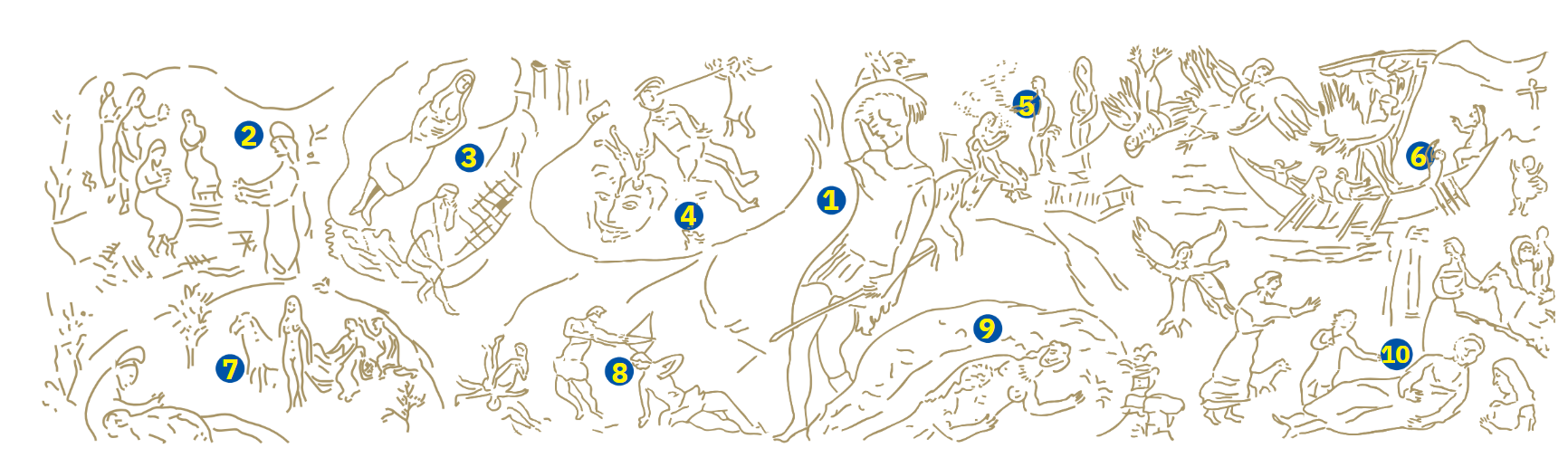
1. Ulysses
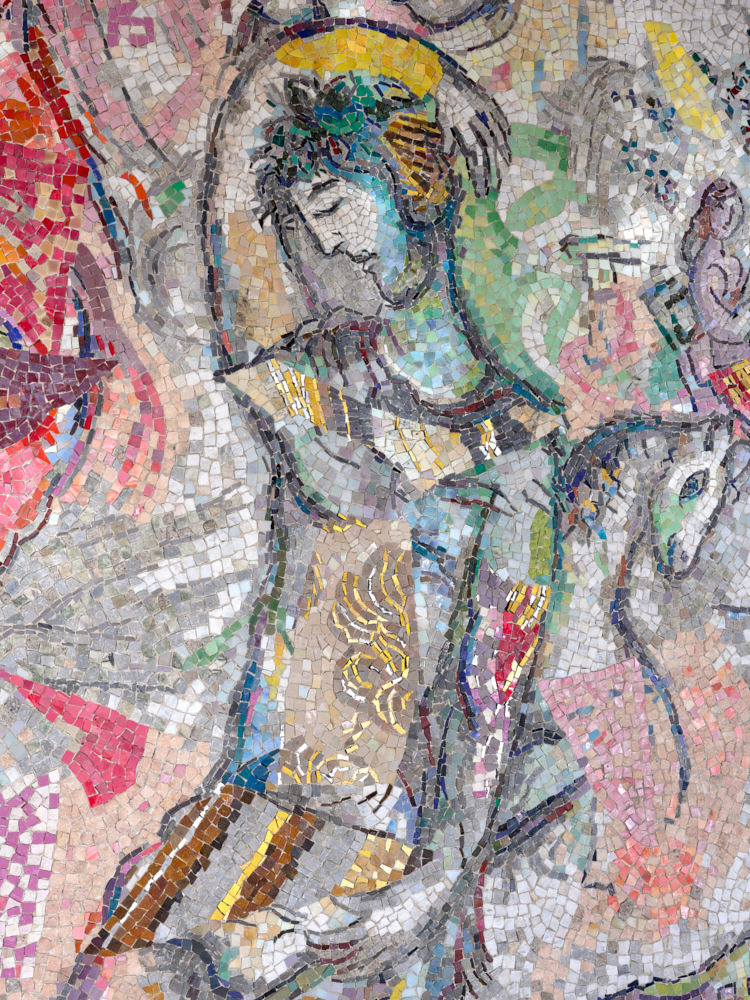 Head bent and curled under his right arm, Ulysses wears a gentle, inspired expression. Rather than portraying him as a warrior, Marc Chagall celebrates the hero’s soul—brimming with courage and wisdom—illuminated by the shimmer and swirl of gold and colored tesserae.
2. The Assembly of the Gods on Olympus (Odyssey, Canto V)
 Before Zeus and the gathered gods, Athena—the goddess of intelligence and wisdom—pleads for Odysseus’s return to Ithaca, as he is kept captive by the nymph Calypso. The fate of the Greek hero is thus bound by divine decree.
3. Calypso (Odyssey, Chants V and XII)
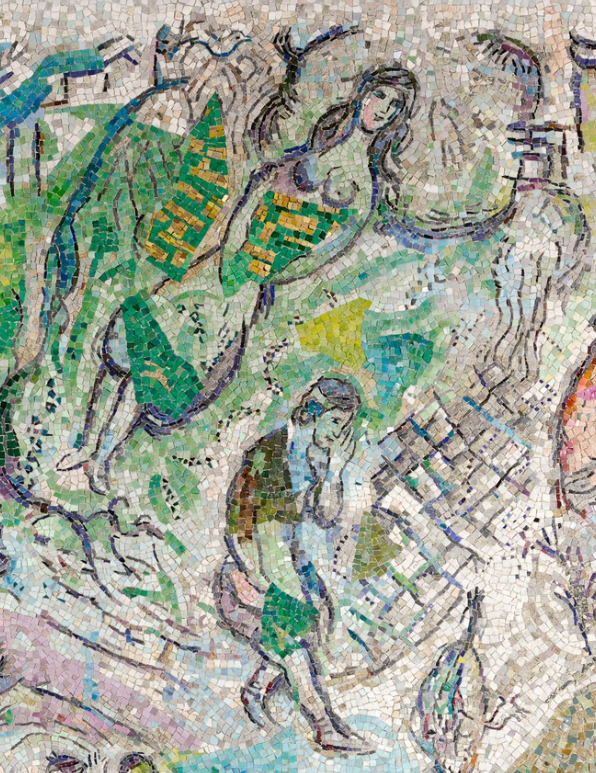 After a shipwreck, Ulysses is welcomed and cared for by Calypso, the sea nymph, with whom he stays for seven years. She offers him her love and promises him immortality. Yet, despite her affection, Ulysses turns his back on her, physically and mentally preparing to leave, his thoughts fixed on his home and his wife Penelope.
4. Polyphemus (Odyssey, Canto IX)
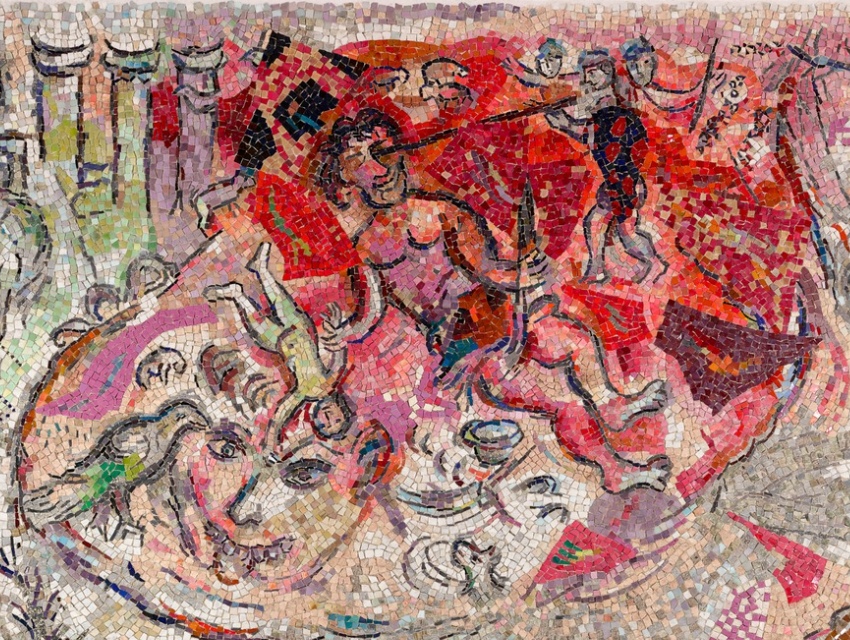 Rendered in a violent red tone, Ulysses drives a stake through the eye of Polyphemus, the drunken and drowsy Cyclops. The King of Ithaca is surrounded by his surviving companions and sheep, that, thanks to his cleverness, will enable him to escape the cave of the Cyclops, a figure of bestiality and cruelty.
5. Circe (Odyssey, Canto X)
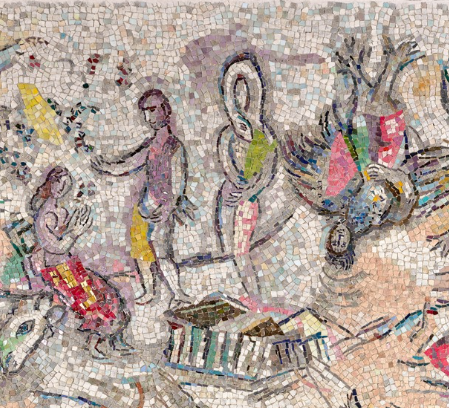 With the help of Hermes, the god of cunning, Ulysses thwarts the magic and enchantments of Circe, who has transformed his companions into animals. Instead of depicting them as pigs, as in the Odyssey, Marc Chagall imagines a man with the head of a swan or a snake.
6. The Sirens (Odyssey, Canto XII)
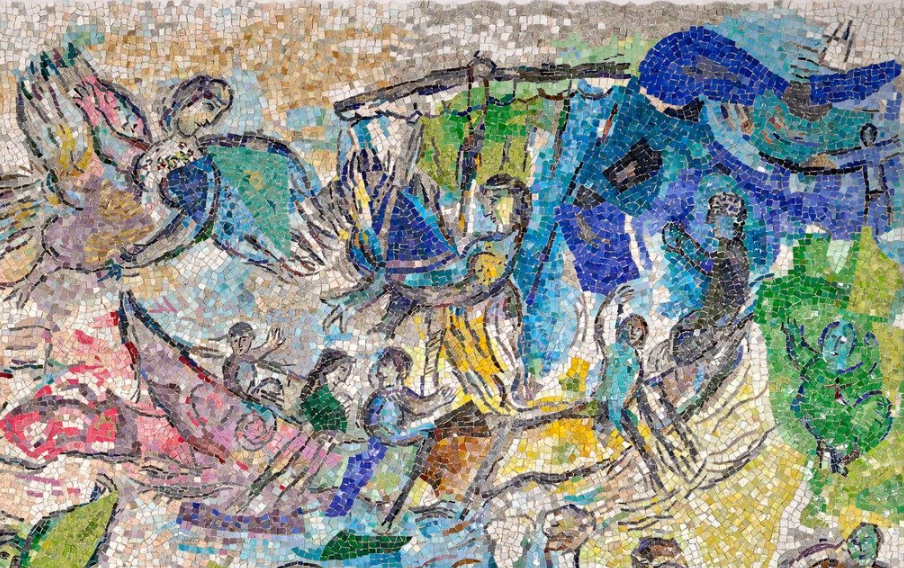 Portrayed as women-birds, the sirens attempt to seduce Ulysses and his crew with their enchanting song and the promise of knowledge. To resist their spell and avoid shipwreck, Ulysses plugs his companions’ ears with wax and chooses to face the danger alone, seated at the prow of the boat.
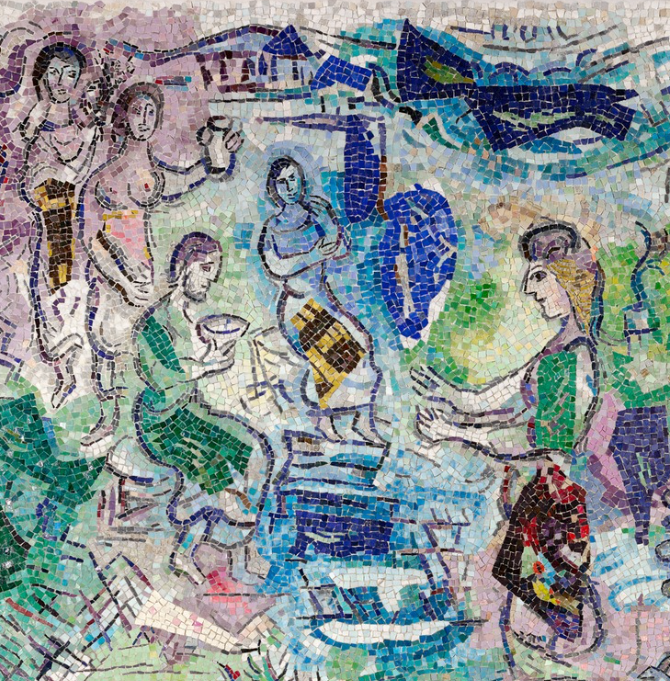
7. Nausicaa (Odyssey, Canto VI)
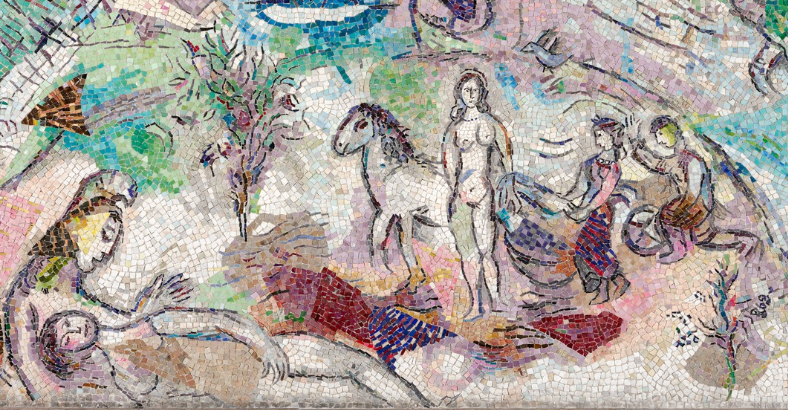 Rejected by the sea after a final shipwreck that left him naked and without food, Ulysses has fallen asleep in the arms of Athena, who is once again watching over him. To their right, another scene depicts the hero kneeling before the princess Nausicaa, whose beauty, virtue and hospitality captivate and test the mature man with the temptation of impossible desire.
.
8. The Bow (Odyssey, Cantos XXI and XXII)
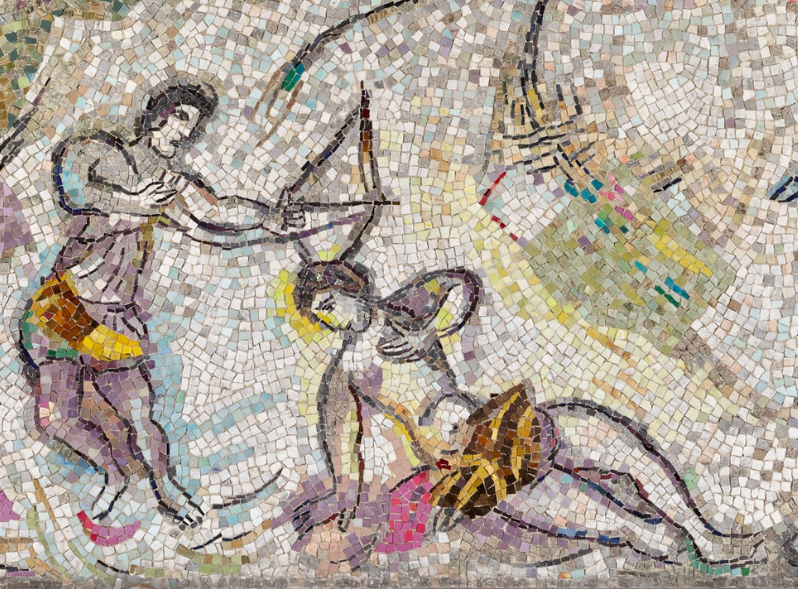 Back in Ithaca and disguised as a beggar, Ulysses faces one last battle against the ennemies vying to rule his kingdom and win Penelope’s favor. Seizing the great bow—one that none had been able to bend until then—he uses his strength and courage to defeat the pretenders, who fall lifeless to the ground.
9. The Nuptial Bed (Odyssey, Canto XXIII)
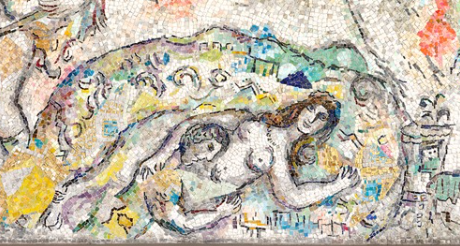 Following his political triumph, Ulysses returns to the arms of his wife, Penelope, in their nuptial bed carved by his own hands from the stump of an olive tree rooted deep within their palace. Surrounded by shimmering colors and rich gold tesserae, the couple embodies the sweetness of home regained and a profound sense of gratitude.
10. Ulysses’ Death
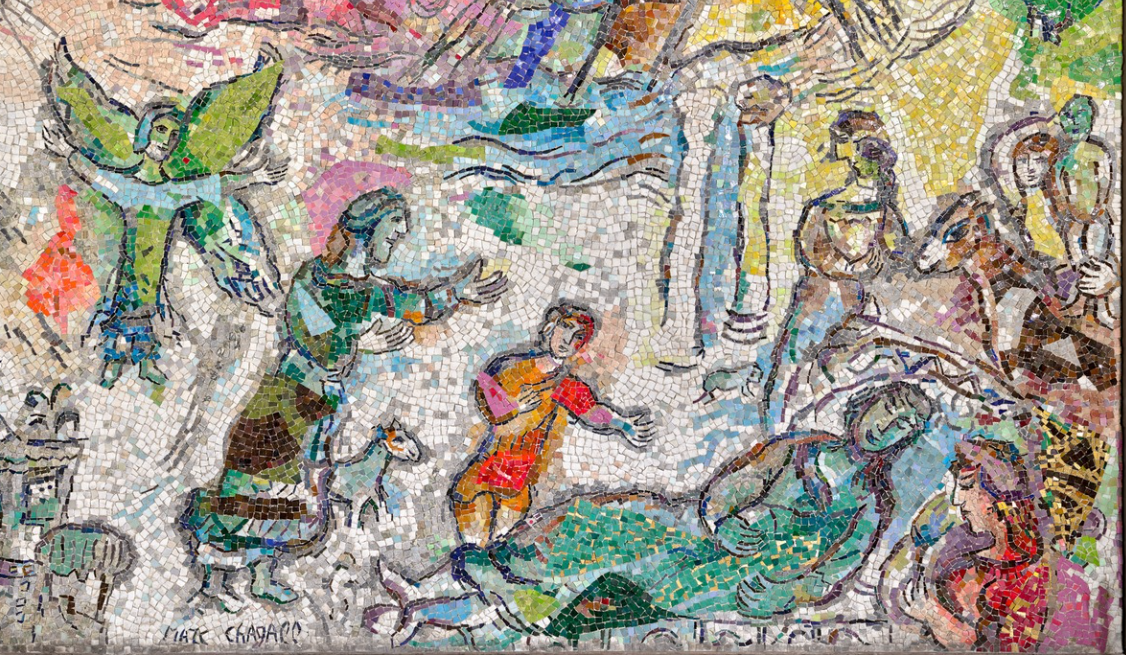 At the end of his epic journey and trials, Ulysses has returned to his city and his home, marking the conclusion of his heroic saga. With freedom and peace, he fulfilled his human destiny by dying peacefully, surrounded by his faithful wife Penelope, his son Telemachus, his father Laërte, the loyal dog Argos, the swineherd Eumaeus, and the nurse Eurycleia.
This podcast was created in collaboration with students from the Association du Débat Niçois (ADN): Gianni Chahdi, Chloé Derrien, Flora Decloy, Mathis Lalande, Michael Molle, Constant Richard, and Isra Sahli. They brought their oratorical talents and rhetorical skills to offer an original interpretation of Marc Chagall’s mosaic.
This project is a joint initiative of the Faculty of Law and Political Science of Nice and the Marc Chagall National Museum.
Visuals: Marc Chagall, Le Message d'Ulysse, 1968 (details, mosaic, 3 x 11 m). Nice, Faculty of law and political science © Photo: François Fernandez / National Museums of the 20th Century in the Alpes-Maritimes © ADAGP, Paris, 2025.
À découvrir
Self-guided Tour of Six Marc Chagall Mosaics on the Côte d'Azur
As part of the exhibition Glass and stone. Chagall in mosaic from May 24 to September 22, 2025.
Exhibition Take-Down - Partial Closure of Galleries

European Heritage Days 2026