

Traduction anglaise des textes de l'exposition
- Introduction
‘The monstrous son of Mondrian and Picabia’, as he described himself, François Morellet (1926–2016) was a self-taught painter who developed a radical approach to geometric abstraction whilst demonstrating complete artistic freedom.
A devotee of mathematical rules – which dictate the creation of the painting and nullify the painter’s subjectivity – Morellet delighted in subverting their rigour by introducing two disruptive elements: chance and disorder. From his early abstract works, influenced by the modernist avant-garde, to his explorations of neon from the 1960s onwards, the exhibition highlights the artist’s sense of humour, which constantly calls upon the viewer’s complicity.
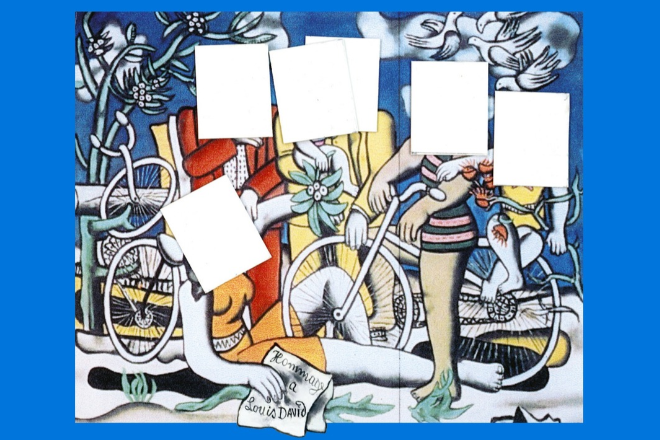
From the 1980s onwards, Morellet also took an interest in the representation of the human figure, with a view to satirising it more effectively in a series entitled ‘Défigurations’. In 2010, he did not hesitate to tackle a 20th-century icon, Les Loisirs – Hommage à Louis David, painted in 1950 by Fernand Léger (1881–1955), by replacing the figures’ faces with uniformly white canvases. For Morellet, as for Léger – who had previously targeted the Mona Lisa – painting appears as a creative, slightly irreverent playground for engaging with the masterpieces of art history.
Building on this shared sense of irony, the Fernand Léger National Museum offers visitors a journey full of surprises, structured around the theme of the representation of the figure – and its disappearance. In 1952, on the occasion of the exhibition « The Figure in the Work of Fernand Léger » at the Galerie Louis Carré, the painter foreshadowed Morellet’s remarks by stating, with a touch of provocation: ‘In the evolution of my work […], the human figure remains deliberately expressionless. I know that this very radical conception of the figure-as-object offends quite a few people, but there’s nothing I can do about it.”
This tribute exhibition thus reveals an unexpected dialogue between two artists from different generations who also share a predilection for the geometry of forms and a desire to literally take painting out of the frame by introducing the effects of light.
François Morellet: a few key dates
1926: Birth in Cholet
1945–1949: Alongside his early figurative paintings, François Morellet worked in the family toy-making business, which he ran until 1975. A self-taught painter, Morellet was initially influenced by the arts of Oceania, which he discovered at the Musée de l’Homme in Paris.
1950: Under the influence of the Dutch painter Piet Mondrian (1872–1944), Morellet abandoned figurative art and created his first geometric paintings. From then on, he adopted a visual language consisting of simple forms – lines, dashes, squares – arranged uniformly across the surface of the canvas. These ‘all-over’ compositions play with a limited number of colours and show no apparent brushwork, evoking industrial manufacturing processes.
1951–1952: During a trip to Brazil, Morellet discovered the works of the founder of Art Concret, Max Bill (1908–1994). At the same time, a visit to the Alhambra in Granada introduced him to the decorative interlacing patterns of Hispano-Moorish art. This dual revelation, which proved decisive for the development of his work, led him to base his painting on a ‘system’ – a coherent ensemble composed of the repetition of geometric patterns.
1958–1960: Morellet introduced mathematical principles into his early grid works and began to compose his paintings based on chance, which dictated the creation of the artwork in a random manner. Thus, in certain works, the distribution of colours was determined – in a playful and offbeat spirit – by the even or odd numbers in a telephone directory or the decimal digits of the number π.
1961: Together with the artists Julio La Parc, Horacio Garcia Rossi, Francisco Sobrino, Stein and Yvaral, he founded the Groupe de Recherche d’Art Visuel (GRAV), which remained active until 1968, and published the manifesto ‘Enough mystifications’. This seminal text challenges the traditional art object and the cult of the artist’s personality: it criticises elitist art and advocates an art form that places the public at the heart of the artistic experience through movement and games.
1962–1964: Morellet created his first sculptures, entitled Sphères-trames, which could be handled by the public. He conceived his first monumental installations incorporating electric light bulbs and neon tubes, such as the collaborative work Labyrinthe, presented at the 3rd Paris Biennale. His work enjoyed international success with exhibitions organised in Europe, Japan and Latin America.
1967: First acquisition of a work by Morellet for a French museum in Strasbourg and first solo exhibition at the Denise René Gallery in Paris.
1971: Created his first site-specific work, or ‘architectural integration’, facing the future Centre Pompidou, which was followed by around 150 commissions for public spaces, both in France and abroad.
1987–1988: In the 1980s, Morellet made more systematic use of puns and humour in the titles of his works. He began the ‘Steel Life’ and ‘Défiguration’ series, which involved placing white canvases where the faces of icons from art history would normally be.
1990–1992: Morellet unveiled five monumental commissions, including La Défonce at the La Défense site in Paris and Le Naufrage de Malevitch at the Kerguéhennec estate in Brittany. He developed an interest in late German and Austrian Baroque, leading to a return of curves and circles in his work. He began his ‘Relâche’ series as a tribute to Francis Picabia.
2016: Death of François Morellet in Cholet.
- Front Room 4
Léger and the figure object
The painter Fernand Léger had an ambivalent relationship with the depiction of the human figure. As a leading figure of the avant-garde, he made it a point of honour to challenge all conventions inherited from the past: and what could be more emblematic of the academic tradition than the human figure, the heroine of history painting, that quintinssential noble genre ?
One of Léger’s concerns was to strip away the sentimentality attributed to figures in order to focus on the composition of the painting: ‘The object has replaced the subject; abstract art came as a total liberation, and we were then able to consider the human figure not as a sentimental value but solely as a plastic value.’ At the same time, he revitalised the subjects of his painting by drawing inspiration from the world around him, everyday objects or the industrial products of modern society.
But contrary to the painter’s own assertions, the human figure is omnipresent in his work. He approaches it in various ways: he breaks it down into facets during his Cubist period; then, having been deeply affected during the Great War by ‘a 75-millimetre breech lying open in the blazing sun’, he depicts it as an assemblage of mass-produced cylindrical tubes.
Influenced by the moving images of cinema, he focuses his attention on details, observed in close-up, which convey a fragmented perception of the human body. Thus, the hand pattern – the tool of both the painter and the worker – features regularly in the preparatory drawings for the ‘Constructeurs’ series, as well as in his variations on the ‘Visage à la main’, where it symbolises feminine beauty.
In the 1930s, Léger fragmented the figures of bathers and dancers whilst giving them a monumental silhouette that filled the entire canvas. From the time of his exile in the United States between 1940 and 1945, he started depicting the twirling, black-outlined bodies of acrobats and divers in mid-air, capturing their dynamism, flexibility and boundless freedom.
Checkerboard patterns
In the 1920s, Fernand Léger returned to classical subjects with a series of paintings depicting women in interiors. In Les Femmes au bouquet, he continued the simplification of the human anatomy that he had begun during his Cubist period. These powerful, hieratic women, whose faces are devoid of any individual expression, pose against a backdrop where traditional perspective gives way to an abstract, colourful background, influenced by the works of Piet Mondrian (1872–1944).
Léger pays meticulous attention to the decorative elements surrounding the figures. The checkerboard pattern, a recurring feature in his works, as seen in Étude pour un portrait, serves several purposes. It suggests the idea of play and entertainment, whilst introducing strong contrasts between black and white. Through the repetition of the square, he alludes to geometric abstraction.
The title of François Morellet’s painting, 1 carré jaune sur 3 blancs, clearly describes the principle underlying the composition. The artist suppresses any representation of the real world, retaining only the checkerboard pattern, which becomes the sole subject of the painting. The artwork is nothing more than the physical elements of which it is composed, devoid of any meaning or symbolism.
This Morellet artwork is the result of a dual aesthetic influence in the 1950s: the discovery of the work of the abstract painter Max Bill (1908–1994) and the decorative interlacing patterns of the Alhambra in Granada. The minimalist nature of the painting, combined with the inclusion of a few touches of yellow—which contrast with the restraint of the colour palette—creates an illusion of depth and movement.
By employing a system based on the repetition of geometric patterns, Morellet controls the creative process in the manner of industrial production. He demystifies the concept of art which, in his view, stems from the Romantic ideas of the nineteenth century: ‘I am obviously less interested in the result than in the system itself’. He reduces his own subjectivity. However, by creating an almost hypnotic optical effect, he reintroduces that of the viewer through an individual sensory experience.
- Room 4
Letting the light shine
During his exile in the United States, whilst the Second World War was raging, Léger was captivated by this ‘transparent, translucent New York, with its blue, red and yellow storeys ! A magical experience, with the light unleashed by Edison piercing through it all and shattering the architecture.’ As a painter of modernity, Léger transposed the electric lights he observed on the streets of New York into his paintings and developed the concept of ‘colour outside’, which involves separating colour from design to create the illusion of the movement of spotlights.
Whilst Léger rendered the effects of light using strictly pictorial means, Morellet began incorporating artificial light sources – in particular neon – into his works from 1963 onwards, in order to give them ‘the prominent place they deserve within the aesthetic arsenal’. Whilst Léger admires coloured light, which envelops reality in its magical aura, Morellet appreciates its sharp, crisp effect, devoid of shadows and reflections. He explores all its artistic possibilities: variations in colour and rhythm, the intensity of the lighting, and the architectural relationship to space.
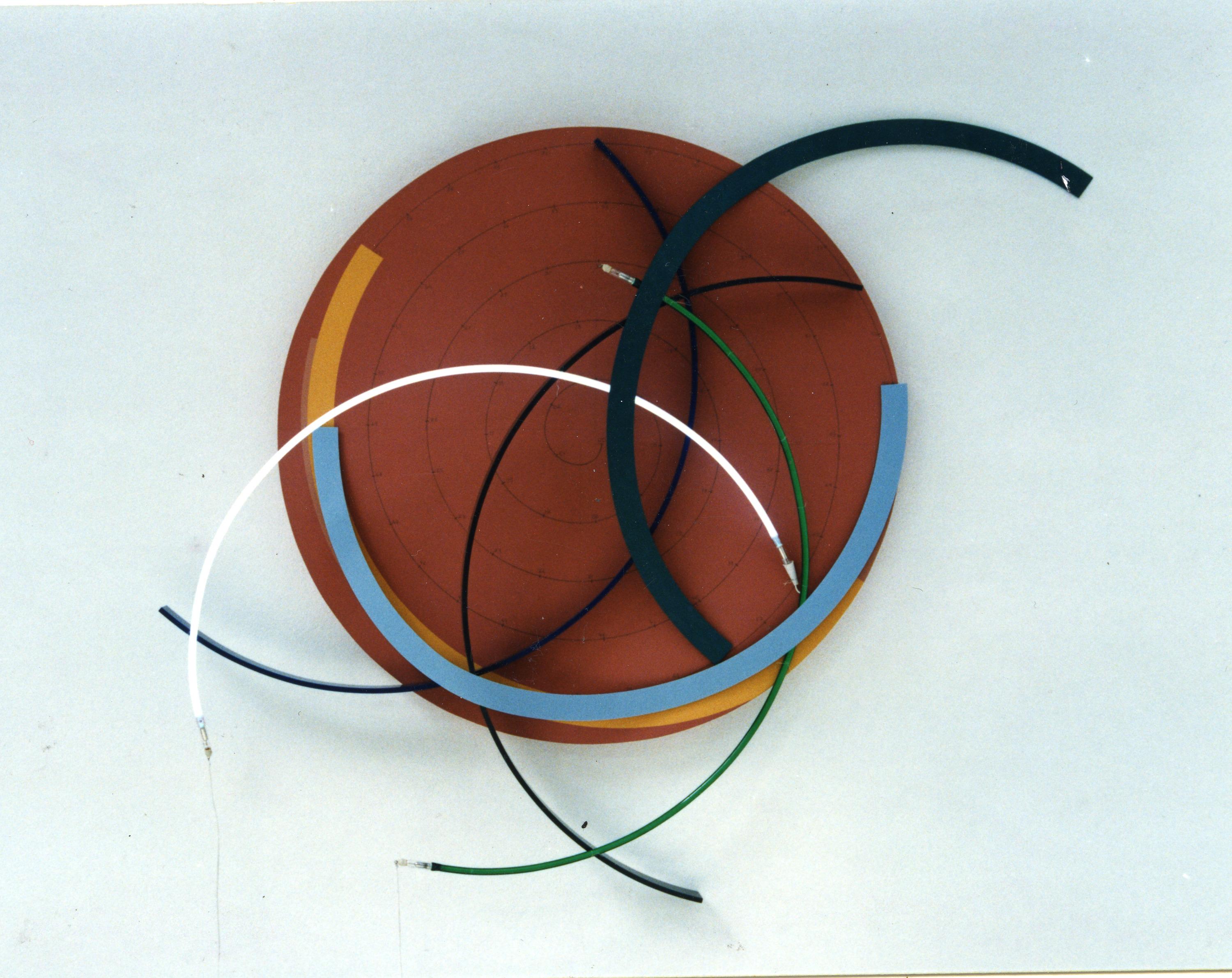
In 1996, Morellet launched ‘Lunatique’, a series of pieces composed of coloured neon tubes and an interweaving of various circular elements. In keeping with his taste for random creative processes, numbers from the Maine-et-Loire telephone directory were used to determine the fulcrums of the arcs as well as their angle of inclination. This superimposition of randomly selected elements creates an impression of disorder, verging on confusion, in a baroque spiral that contrasts with the usual rigour of Morellet’s works.
Abandoning his favoured shape, the square pattern, the artist opted for circular forms in reference to the moon and to its influence on behaviour. Entitled Constellation, the polychrome plaster model, created in 1943 by Léger and the American sculptor Mary Callery (1903–1977), also embodies this cosmic dimension. The pure colours and randomly arranged protruding elements, seem to break free from the flat surface and project themselves into space. By creating effects of light and movement, the two artists play with architecture and monumentality.
Depicting the absence of a figure
From 1988 onwards, François Morellet’s ‘Défigurations’ series playfully subverts masterpieces from art history by replacing the figures’ heads with uniformly white canvases. For example, the artist ‘disfigures’ Eugène Delacroix’s La Mort de Sardanapale (1827), which he references through fifteen white rectangles hung on the wall in the same arrangement and proportions as the original painting. Through this iconoclastic gesture, the artist reappropriates the icons of history whilst questioning their almost sacred status.
In 2010, Morellet set his sights on a major work by Fernand Léger, created in 1948–1949 and presented at the Musée national d’art moderne – Centre Pompidou: Les loisirs – Hommage à Louis David, of which the Musée national Fernand Léger holds a version on a red background.
True to his mischievous spirit, the artist explains that he selected the masterpieces based on their format, following a study by the historian Anne Granon, which concluded that most of them were painted on canvases measuring 92 x 73 cm. Eager to make this format his own – to give himself the opportunity to create masterpieces of his own – he set about, somewhat absurdly, disfiguring these works by using this standard format. Or perhaps, as he puts it himself, did he wish to ‘justify the pleasure [he] has taken (for the past few years) in hanging white canvases chaotically on a white wall’?
In addition to the barely veiled reference to another revolutionary masterpiece of 20th-century art history, Carré blanc sur fond blanc (1918) by the Russian painter Kazimir Malevich (1879–1935), is this not also a way for Morellet – even though he denies it – to proclaim his love of painting and his admiration for the great painters who came before him?
The fragmented figure
In 2009, François Morellet created this monumental work, which he titled Gesticulation, consisting of six white neon tubes connected by power cables of equal length. Whilst the industrial neon tubes form a geometric shape, the loose wires, hanging at varying lengths, introduce supple, semi-circular lines that contrast with the rigidity of the neon tubes. The ensemble creates an impression of disorder and chaos within a composition that is, on the surface, strictly geometric.
The title and form of the artwork suggest, in a manner that is unusual in Morellet’s oeuvre, the presence of the human figure and the idea of the body’s disordered movement. The schematic silhouette, evoked through a rough assemblage of straight lines, is reminiscent of the ‘stick figures’ drawn by young children, which are both amusing and touching. Does the title refer to the turbulence of childhood or to the rhythmic movement of a dance? In any case, the artwork introduces the notions of joy and spontaneity into the rigorous world of abstraction.
In his iconic painting Esquisse pour la femme en bleu, from 1912, Léger also plays with the opposition between a network of straight lines and the curved forms of the background. Through this interplay of contrasts, he breaks down the portrait of the figure and produces dynamic effects within a radiant composition. In the works of Léger and Morellet, the figure serves as a pretext for giving the viewer the illusion of movement.
Diagonally
Between 1987 and 1991, François Morellet created a series entitled ‘Steel Life’, comprising a total of 23 works. Each of these pieces consists of two distinct elements – a square white canvas and a flat iron bar intended to serve as its frame – giving rise to multiple variations on the wall and in space.
As it was often the case in his work from the 1980s onwards, Morellet chose a pun for the title. ‘Steel Life’ plays on the similarity to the phrase, ‘Still life’, which refers to the genre of still life in painting. The word ‘steel’ substitutes industrial modernity for the illusionist depictions of flowers, fruit and objects found in traditional painting. Morellet makes use of this homonymy to evoke this theme from classical painting whilst replacing it with a canvas devoid of any figurative elements.
In Steel Life n° 24, Morellet retains a taste for trompe-l’œil effects from traditional painting: the black line, painted onto the canvas, creates the visual impression that the white canvas breaks free from the metal frame, which prevents it from moving on the wall. Nevertheless, this new kind of still life seems to come to life, animated by the disorderly and unpredictable movement of the metal frame. By creating tensions between the canvas and the metal, between reality and optical illusion, Morellet introduces the idea of movement into this ‘Steel Life’ series. Similarly, as the viewer cannot discern from a distance where the flat iron begins and ends, the artist invites him to position himself facing the artwork to find out for himself.
- Room 1
Geometric abstractions
Between 1924 and 1926, in a rare series of paintings intended to be enlarged to the scale of a monumental mural, Fernand Léger expressed his desire to fuse modern painting and architecture. Composed of colourful and dynamic frontal geometric planes, Peinture murale (1926) reflects the influence on the artist of the Dutch De Stijl movement, in particular that of Piet Mondrian (1872–1944), whom Léger discovered in 1923 at an exhibition at the L’Effort moderne gallery organised by his art dealer, Léonce Rosenberg.
In the 1930s, Léger joined various groups promoting abstract art, in reaction to Surrealism, which was then dominating the art scene. In the spring of 1931, he took part in the first international exhibition of the Cercle et Carré group, founded in 1929 and bringing together diverse artists such as Jean Arp, Jean Gorin and Joaquín Torres-García. He then joined the Constructivist-inspired group Abstraction-Création, founded in 1931 by Auguste Herbin and Georges Vantongerloo.
For his part, François Morellet, a self-taught painter, produced figurative works – landscapes, still lifes and portraits – in a dark colour palette and with an impasto technique until 1949, before turning to abstraction under the influence of the painters of the École de Paris, in particular Serge Charchoune and Pierre Dmitrienko.
This new, minimalist style saw the emergence of several characteristic features of his future work: the predominance of the colour white, in a subtle interplay of tone-on-tone, and the creation of a complex network of lines. In the early 1950s, Morellet discovered the principles of ‘Art Concret’ as defined by Theo Van Doesburg in his 1930 manifesto, and then, during a stay in Brazil in 1951, the work of Max Bill. Similarly to Léger, the simplicity and universality of Piet Mondrian’s visual vocabulary had a lasting influence on the development of his work.
Not quite square !
From 1952 onwards, François Morellet chose to paint almost exclusively on square canvases and explained this preference as an ‘inexorable and systematic quest that can be summed up as: “How can I do as little as possible?”’ He took this logic of economy of means to the point of absurdity: ‘The square, as we know, requires only one arbitrary decision to be defined, whereas the rectangle requires twice as many.’
But beyond the simplicity of its form, Morellet adopted the square because he appreciated its perfect symmetry and formal neutrality, which convey a sense of calm and stability. Yet the artist takes pleasure in disrupting it, turning it upside down on the wall to introduce movement, or even a ‘discreet and absurd’ disorder, into the order and regularity.
In 2002, François Morellet’s ‘Ratés’ series subverted a creative process developed in a work from 1957. The artist was experimenting with the possibility of forming a perfect square from 16 L-shaped modules. Here, the new assembly does not produce a perfect square: it breaks free from the constrained form of the square and escapes beyond the frame, asserting its autonomy on the wall. Raté n°10 thus reveals the wooden panel in the places where the assembly has failed. With a touch of self-deprecation, the artist introduces the notion of failure into the work, as if the painter’s work were the result of a (mis)fortunate coincidence.
Léger’s Composition murale (1924) also appears to spill out beyond the frame. The painter seeks to transcend the confines of the easel painting in order to bring the minimalist spaces of modern architecture to life. He engages with the viewer’s visual perception through optical illusions that create an impression of depth and movement. The physical properties of colour, the dynamic arrangement of planes, and the active participation of the eye give rise to what Léger calls an ‘elastic rectangle’: ‘Colour is a powerful means of action; it can destroy a wall, […] it can make it recede or advance; it creates this new space. ’
Like Léger, Morellet produces playful works that invite the viewer to become an active participant in his art. By emancipating himself from constraints, the artist boldly and freely embraces the vocabulary of geometric abstraction to create a vibrant dialogue between art, architecture and the public.
Disfiguring the grid
In 1994, Théodora, aged 3, drew a picture in felt-tip pen, based on a geometric pattern by François Morellet. This child’s drawing in turn served as the model for the neon piece presented here, RECREATION No. 8. The neon composition is surprising because, rather than displaying industrial straight lines, the neon tubes echo the colour palette of the original drawing and faithfully mimic the child’s clumsy, shaky strokes.
At first glance, the title of the work describes, in a matter-of-fact manner, the chronology and the various stages of the work’s creative process. Yet its offbeat phrasing comes across as a playful parody of the myth of the artist as a creative genius. By placing his work on the same level as a child’s drawing, Morellet questions the status of the artist, which he hopes to demystify.
The near-homonymy of the words ‘Recréation’ and ‘Récréation’ humorously intertwines the worlds of art and childhood. By suggesting the idea of ‘playtime’, he challenges the seriousness of the art world, into which Morellet introduces, with great pleasure, entertainment, play and humour. Through this series of works, he argues that the act of artistic creation is within everyone’s reach, including children.
Sixty years earlier, another Théodora – a young German student who, from 1928 to 1934, studied under Fernand Léger at his Académie moderne in Montparnasse, Paris – followed in her master’s footsteps. At the time, Théodora Bücking-Klute produced, probably with Léger’s assistance, carpet designs that bear witness to their shared desire to promote modern art through the creation of decorative art objects, in the style of the multidisciplinary German Bauhaus school.
These drawings, which echo Léger’s contemporary pictorial explorations, such as Composition à la feuille (1927), constitute a series of variations on combinations of colours and geometric shapes. One of them features a distorted grid, reminiscent of the neon composition RECREATION No. 8. By disrupting the strict geometry with a random undulating movement, Fernand Léger anticipated François Morellet’s iconoclastic approach.
Credits:
François Morellet, Lunatique couleurs hasardeuses n°2, 1996, Tubes de néon, aluminium laqué, ruban de toile, crayon, acrylique et huile sur toile, 153 x 183 cm, Succession François Morellet, n°96008, ©ADAGP, Paris, 2026 / François Morellet.
Fernand Léger, Constellation, 1943, musée national Fernand Léger
À découvrir
Traduzione italiana dei testi di sala della mostra
Traduction anglaise des textes de l'exposition
Léger - Morellet, Dé-figurer la peinture
Du 21 novembre 2026 au 26 avril 2027