

Restoration project
Since October 2024, a vast project has been underway to restore the mosaic on the building's west façade, in order to ensure its lasting preservation.
The work was created in 1989-1990 by mosaic artist Heidi Melano, based on a gigantic painting the artist had done in 1951 for the French pavilion at the Milan Triennale.
Interview with Stefano Marini, site manager and restorer specializing in stonework:
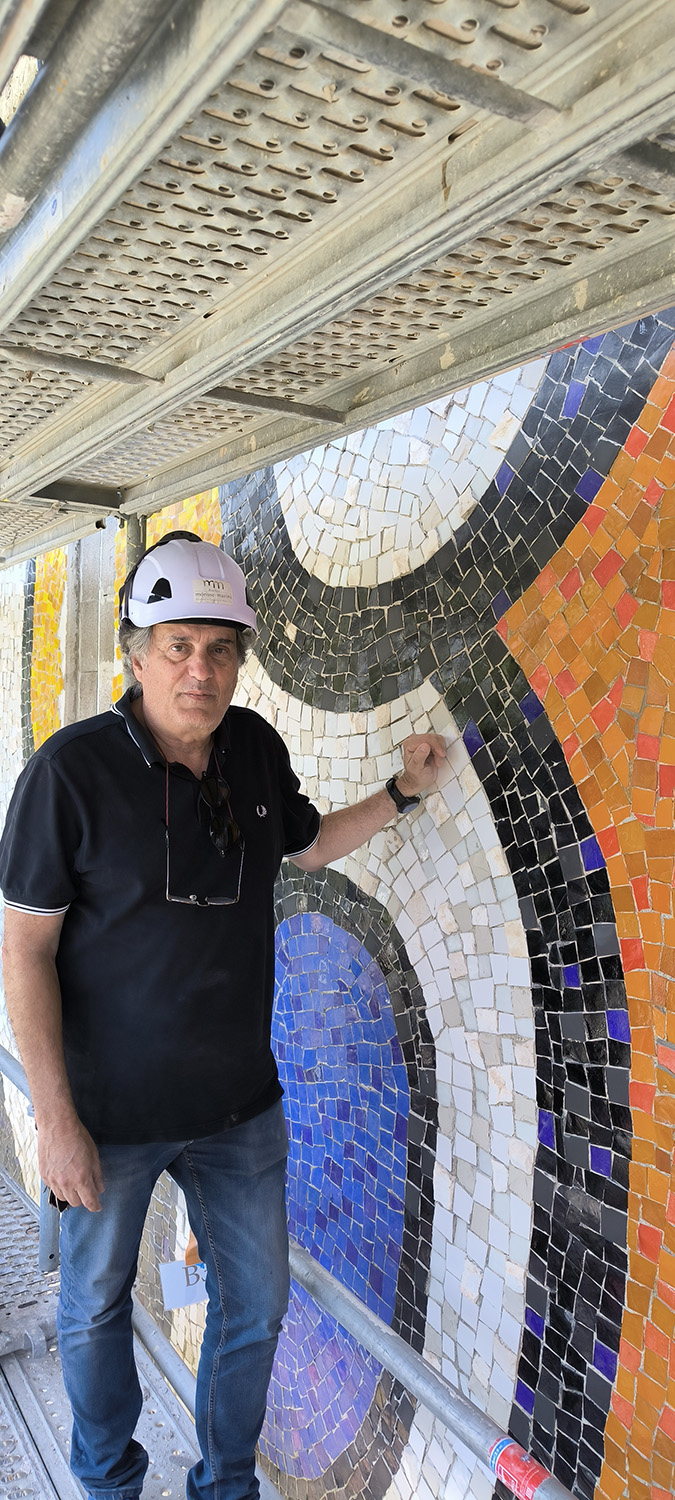 Can you tell us the main reasons for the deterioration of this monumental mosaic?
SM - Monumental, indeed! The work consists of a single panel 12 metres high and 25 metres long, covering an area of 300 m2. It's one of the largest mosaics in the world!
As early as 1992, falling tesserae and horizontal cracks were observed on the surface, particularly in the upper part of the wall. These disorders are due to structural problems, dating back to the construction of the building, linked to the concrete structure on which the mosaic is laid.
Thanks to successive technical studies and surveys carried out in 2023 and 2024, we have gained a better understanding of the fragility of this structure, which was designed, in places, with reinforced concrete, and in others, with simple breeze blocks sealed with cement mortar. It is in this mortar that the deepest fractures are to be found.
Add to this thermal variations and water infiltration, and you have all the ingredients needed for the progressive deterioration of the mosaic.
As a result, several maintenance campaigns were carried out between 1998 and 2016, but it became clear that a more thorough and, above all, more permanent restoration was required.
One of our priorities is therefore to consolidate the entire structure, by creating new expansion joints, enabling the building to move without cracking. Once the building has been stabilized, the colors of the decor can now be restored to their full glory!
How long do you think this restoration will last?
SM - As long as possible! Our duty is to correct existing anomalies as far as possible, while leaving our interventions reversible. Thanks to advances in knowledge, the techniques used by tomorrow's restorers will be different from ours today.
How did you become a heritage restorer?
SM - I'm a restorer and engineer, working in a design office specializing in the conservation of stone works. I have a degree in petrography (rock science) applied to cultural heritage, from the Faculty of Geology in Rome.
I've been lucky enough to work on some major projects in France: following the fire at Notre-Dame de Paris in 2019, I helped restore the cathedral's altars. And since 2023, I've been working in Biot, where I've had the opportunity to meet and talk with Julie Guttierez, the museum's curator, and the entire team on site!
Click here to discover the history of the Milan Triennale.