

Triennale history
Inaugurated on May 13, 1960, the Fernand Léger National Museum in Biot was sold to the French state in 1969 by the museum's owners, Nadia Léger and George Bauquier.
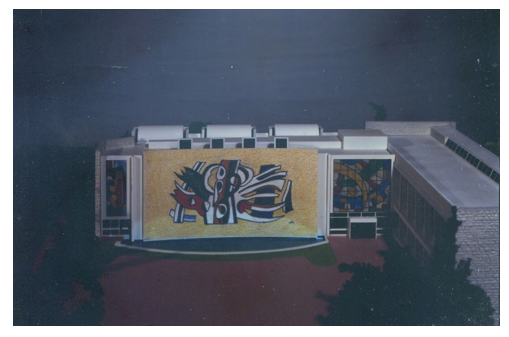
From 1987 to 1990, the Ministry of Culture commissioned Bernard Schoebel, chief architect of civil buildings and national palaces, to expand the building. The construction of a new wing at right-angles to the original building doubled the exhibition space to around 1,500 m². As with the museum's main facade, the decision to integrate Fernand Léger's artistic projects into the building's architecture was repeated in the expansion project. In 1987, when work was undertaken to add a new wing to the museum, Heidi Melano was once again commissioned to decorate the facades of the extension.
Heidi Melano, a master mosaicist
Biot-based mosaicist Heidi Melano (1929-2014) specializes in interpreting works by 20th-century artists. Her late husband, Lino Melano, was Fernand Léger's resident mosaicist. Together, the couple created the museum's first monumental mosaic on the south façade of the original building. At Georges Bauquier's request, Heidi Melano created several monumental mosaics for the museum's new wing. On the park side, the façade features the huge Composition mural painted by Fernand Léger for the French Pavilion at the 1951 Milan Triennial, at the request of Charlotte Perriand.
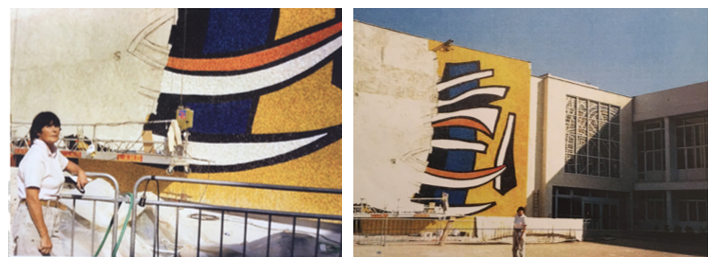
Consisting of a single panel 12 meters high and 25 meters wide, the work is independent of the architecture, resting on a load-bearing structure formed by a concrete frame. The mosaic at the Musée National Fernand Léger covers an area of 300 m2.
The project proved to be a difficult one for the mosaic artist, who had to deal with a number of technical issues. When the work began, her suggestions - to use a plaster-covered mesh to guarantee the mosaic's adhesion - were rejected in favor of another technique: a grid of expansion joints. Later, a problem was detected with the plaster, which was then reworked, while technical disagreements remained latent during the mosaic installation.
The mosaic was finally laid between 1989 and 1990, but the appearance of cracks and falling tesserae was noted as early as 1992. Several restoration projects were carried out between 1998 and 2016, but without succeeding in ensuring the mosaic's long-term preservation. On November 14, 2013, restorer Lionel Lefèvre submitted a condition report on the mosaics on the east and west facades, as well as a report on the mosaics on the east facade, which were experiencing the same problems of instability and falling tesserae.
In 2019, a study was launched to identify the precise causes of major damage to the decor on the museum's west facade. On April 2, 2019, restorer Astrid Maréchaux submitted her condition report. It highlights the absence of any real joints to hold the tesserae together, and focuses on the seven cracks running through the mosaic. Picked up during previous restoration work, these cracks are responsible for the structural deterioration. According to this report, 20 to 30% of the mosaic is hollow and in danger of falling. The lasting solution would be to treat the entire support. This would involve a major operation involving the removal of the mosaic and replacement of the hollow agglomerates. Last but not least, the mosaic façade of Milan's La Triennale is showing signs of weathering due to long exposure to the elements, and in particular to defects dating back to the installation of the original support.
Thanks to the surveys carried out and the diagnosis made, a vast restoration campaign has been underway since the end of 2024, to ensure its long-term preservation. Click here to read an article about the project.
For more information on the buildings and garden, click here.
Photo : View of the west façade of the Musée national Fernand Léger, Biot. Polychrome mosaic created in 1989 by Heidi Melano, based on a mural by F. Léger for the 1951 Milan Triennale © Photo: musées nationaux du XXe siècle des Alpes-Maritimes / Gilles Ehrentrant © ADAGP, Paris, 2025.